


A lobe-style positive displacement pump that has run reliably for months can start showing subtle changes: the flow rate drops a few percent against the same back pressure, the gearbox runs warmer to the touch, or a thin film of product appears around the shaft housing. None of these signals demand an immediate shutdown, but each points to a maintenance task that, if deferred, can turn into a rotor-to-rotor contact incident, a scored shaft, or a seal failure that contaminates the product batch.
The maintenance discipline for a rotor pump centers on three systems: the rotor-to-rotor and rotor-to-housing clearances that determine volumetric efficiency, the mechanical seals that isolate product from atmosphere and gearbox oil, and the gearbox that synchronizes the two rotor shafts. This guide walks through inspection procedures, wear indicators, and corrective actions for each. Many plants also standardize on a rotary lobe pump design for these applications because the accessible front cover and cartridge-style seals simplify the maintenance tasks described below.
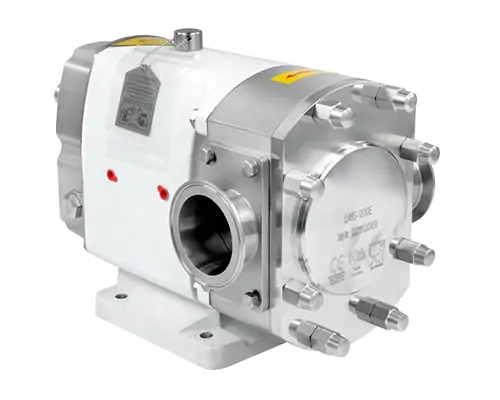
Rotor Clearance: Where Volumetric Efficiency Is Won or Lost
A lobe pump moves fluid by trapping a fixed volume between each rotor lobe and the pump housing, then discharging it on the pressure side. The clearances between the rotor tips and the housing wall, and between the two rotors themselves, directly control how much fluid slips back from the discharge to the suction side. When these clearances open up beyond specification—due to wear, corrosion, or improper reassembly after cleaning—the pump's effective flow rate drops even as the motor runs at the same speed.
How to measure rotor-to-housing clearance. Remove the pump cover and insert feeler gauges between the rotor tip and the housing wall at several points around each rotor's rotation. Compare the readings to the manufacturer's specification, typically in the range of 0.1 to 0.3mm depending on pump size and application. A clearance that is 50% above specification reduces volumetric efficiency enough to affect dosing or filling accuracy.
Rotor-to-rotor timing clearance. The two rotors are synchronized through the gearbox so they rotate in opposite directions without contacting each other. The gap between the rotor profiles—often measured at the closest point between the two lobes—should be checked with feeler gauges as well. If one rotor's timing has shifted due to gear wear or a loose key on the shaft, this gap becomes uneven around the rotation, producing a cyclical knocking sound. Uneven clearance calls for re-timing the rotors per the manufacturer's procedure, not simply adding shims.
What accelerates clearance wear. Abrasive products—slurries, crystallizing solutions, or fluids with entrained solids—wear both the rotor tips and the housing bore. Corrosive cleaning chemicals can etch the stainless steel surfaces over thousands of CIP cycles, gradually opening clearances even without abrasive product contact. Documenting clearance measurements at each inspection establishes a trend line that predicts when rotors or housing inserts will need replacement, allowing the work to be scheduled during planned downtime rather than in response to a failure.
Mechanical Seal Inspection: Catching Leaks Before They Contaminate
The mechanical seal is the barrier between the product zone and the outside environment—and in many hygienic pump designs, between the product zone and the gearbox oil. A seal that begins to leak does not always produce a visible drip. In single-seal arrangements, a slight moisture film around the shaft housing may be the first sign. In double-seal configurations with a barrier fluid system, a drop in barrier fluid level or a change in its color can indicate that product has crossed the inboard seal face.
What to inspect. Remove the pump cover and visually examine the seal faces under good lighting. A healthy seal face appears smooth and uniformly polished. Pitting, radial cracks, or a cloudy, heat-discolored appearance all indicate the seal has been running under stress—whether from dry running, excessive temperature, or chemical attack. Check the elastomer O-rings or gaskets for swelling, hardening, or compression set. A brittle O-ring that has lost its resilience will not maintain the secondary seal, even if the primary seal faces are intact.
Flush and cooling connections. If the seal design includes a flush port—common in applications with sticky or crystallizing products—verify that the flush line is flowing and free of blockages. A clogged flush port allows product to accumulate behind the seal, where it bakes onto the shaft and eventually compromises the seal faces. For double mechanical seals, check the barrier fluid reservoir level and top up with the specified fluid type. Mixing incompatible barrier fluids can cause seal elastomer damage.
When to replace vs. when to adjust. A seal with minor weepage on startup that stops after a few minutes of running may simply need the pump to reach operating temperature for the faces to bed in. A seal that leaks continuously from startup, or one that has developed a steady drip during operation, needs replacement. Replacing seals on a schedule—based on operating hours or batch counts, not just when they leak—prevents unexpected product contamination events. Equipment designed with sanitary lobe pump configurations featuring accessible seal cartridges makes seal changes faster, reducing the downtime penalty of preventive seal replacement.
Gearbox Care: The Timing System That Synchronizes the Rotors
The gearbox in a Rotary lobe pump performs a critical function beyond speed reduction: it keeps the two rotor shafts perfectly timed so the lobes intermesh without contact. Gearbox problems often announce themselves audibly—a rhythmic knock, a whine that changes pitch with speed, or a rattle at startup that fades as the oil warms up.
Oil level and condition. Check the gearbox oil level at least monthly. Oil that appears milky or emulsified indicates water or product ingress through a failed shaft seal. Oil with a burnt smell or dark, sludgy appearance has oxidized and lost its lubricating properties. Both conditions require immediate oil change and investigation of the root cause before the gears or bearings suffer permanent damage.
Oil change intervals. The manufacturer's recommended interval—often 2,000 to 4,000 operating hours for mineral gear oils in sanitary pump service—should be treated as a maximum, not a target. Pumps running in hot environments or at the upper end of their speed range benefit from more frequent changes. Synthetic gear oils offer longer service life and better high-temperature stability but must be compatible with the gearbox seals and internal coatings.
Bearing and gear wear monitoring. During oil changes, inspect the drained oil for metallic particles. A small amount of fine metallic dust suspended in the oil is normal wear; visible flakes or chips indicate gear spalling or bearing cage failure. If the gearbox has a magnetic drain plug, the quantity and size of particles captured on the magnet provide a simple wear indicator. Increasing particle accumulation over successive oil changes signals that gear or bearing wear is accelerating, and a gearbox overhaul should be planned.
Building a Maintenance Calendar
The three maintenance areas—rotor clearance, mechanical seals, and gearbox—fit into a practical schedule:
Weekly (visual checks). Check gearbox oil sight glass for level and color. Look for any moisture or product film around the shaft housing. Listen for unusual gearbox noise during operation. Verify seal flush flow if equipped.
Monthly (measurements). Measure and record rotor-to-housing and rotor-to-rotor clearances. Compare to previous readings. Inspect seal faces and O-rings during a planned pump opening. Check and top up barrier fluid in double-seal systems.
Quarterly to semi-annually (fluid changes). Drain and replace gearbox oil. Inspect drained oil and magnetic plug for wear particles. Verify rotor timing and adjust if clearances are uneven. Replace mechanical seals if approaching their service life limit based on operating hours.
From Inspection to Reliability
A lobe pump that receives regular attention to its clearances, seals, and gearbox can deliver years of reliable service in demanding hygienic applications. The key is consistency—performing inspections on a fixed schedule, recording measurements so trends become visible, and replacing wear components before they reach failure conditions. The cost of a scheduled seal change or gearbox oil change is small compared to the cost of an unplanned production stop or a contaminated batch.