


A flow control unit that performs flawlessly in an industrial water line can become a contamination risk the moment it is installed in a dairy, pharmaceutical, or cosmetics facility. The difference is not always visible on a specification sheet. It lives in the material certificates, the surface finish measurements, and the way the valve body drains after a cleaning cycle.
Selecting the right component for a hygienic process means looking beyond the flow coefficient. It requires an understanding of how the equipment interacts with the product, the cleaning regimen, and the regulatory framework that governs the facility. This guide walks through the five factors that matter most when evaluating options for sanitary flow regulation.
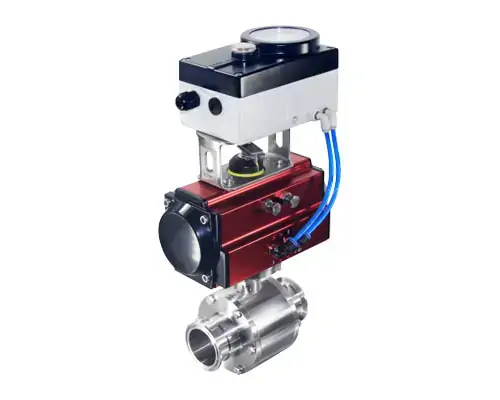
1. Body Material and Product Contact Surfaces
The material of the valve body and all wetted parts determines both chemical compatibility and cleanability. For most food, beverage, and pharmaceutical applications, 316L stainless steel is the baseline requirement. The "L" designation indicates low carbon content, which improves corrosion resistance after welding—a critical consideration when the component will be welded into a process line rather than connected with clamps.
Beyond the alloy specification, surface finish matters just as much. Surface roughness, typically expressed as an Ra value in microinches or microns, directly affects how easily bacteria and product residue can adhere to the metal. For hygienic service, an Ra of 0.8 μm (32 μin) or better is common for internal wetted surfaces. The finish should be achieved through mechanical polishing, which creates a smoother, more repeatable surface than electropolishing alone, though many specifications call for both—mechanical polishing followed by electropolishing to remove surface impurities and enhance the passive layer.
When evaluating a regulator valve for hygienic service, request material certificates that trace the alloy back to the mill heat number. This documentation is not optional in regulated environments; it is a fundamental part of audit readiness.
2. Sealing Materials and Temperature Compatibility
The seals inside a flow control device—O-rings, diaphragms, stem seals—are often the first components to fail in hygienic service. They face a double challenge: they must resist chemical attack from cleaning agents while maintaining dimensional stability through extreme temperature swings.
Ethylene Propylene Diene Monomer (EPDM) is the most common choice for food-grade seals because it resists polar solvents, hot water, and many CIP chemicals. However, EPDM degrades when exposed to fats and oils, making it unsuitable for applications involving edible oils or certain cosmetic ingredients. In those cases, Fluoroelastomer (FKM, often known by the trade name Viton) offers better chemical resistance but at a higher cost and with slightly less flexibility at low temperatures.
Polytetrafluoroethylene (PTFE) is the most chemically inert option and handles a broad temperature range, but it is less elastic than rubber compounds, which means the sealing design must compensate with mechanical loading. For aseptic applications, PTFE diaphragms paired with EPDM backing cushions are common because they provide chemical resistance on the product side with mechanical resilience behind.
The key question to answer is what the seal will see during the full cycle: not just the product temperature during processing, but the cleaning solution temperature during CIP, the acid wash concentration, and the steam temperature during sterilisation. A seal that works at 80°C product contact may fail after repeated exposure to 130°C steam if not specified correctly.
3. Surface Finish Standards and Certifications
Surface finish is not just a number on a drawing. It is a measurable, verifiable characteristic that regulatory bodies and end customers increasingly require documented proof of. Two standards dominate the hygienic valve market: ASME BPE, which governs bioprocessing equipment, and 3-A Sanitary Standards, which cover dairy and food processing.
ASME BPE specifies surface finish requirements in detail, including not just the Ra value but also the method of measurement, the sampling plan, and the maximum allowable defect size. A valve body that meets ASME BPE SF4 (Ra ≤ 0.51 μm internally, electropolished) represents a significantly higher level of finish control than a general industrial component labeled "sanitary finish."
3-A certification goes beyond material and finish to address cleanability and drainability as a complete system. A component bearing the 3-A symbol has been evaluated for its ability to be cleaned in place without disassembly, which means the body geometry, seal design, and internal contours all work together to prevent product entrapment.
For facilities subject to FDA oversight under 21 CFR Part 11 or similar frameworks, the documentation trail matters as much as the hardware itself. When reviewing specifications for pneumatic control valves for sanitary service, confirm that the manufacturer provides full material traceability and surface finish certification with each unit.
4. Cleanability and Drainage Geometry
A flow control device that cannot drain completely becomes a contamination risk the moment the cleaning cycle ends. Residual liquid sitting in a valve pocket, however small, provides a medium for microbial growth. This is why drainability is not a "nice to have" in hygienic design—it is a fundamental requirement.
Valve body orientation plays a decisive role. A component mounted with its actuator on top and the body in a vertical or near-vertical position generally drains better than one mounted horizontally. Some designs incorporate a slight internal slope in the body cavity to direct liquid toward the outlet. Others use a weir-type body that naturally channels flow.
The port configuration also affects cleanability. A full-bore design with no internal steps or recesses allows cleaning solution and product to flow without creating dead legs. If the valve must be reduced in size, the reduction should be smooth and tapered rather than stepped, to avoid creating a ledge where product can accumulate.
CIP (Clean-in-Place) compatibility should be confirmed with the manufacturer, not assumed. Even a valve with excellent surface finish may have internal crevices that cleaning fluid cannot reach at the specified flow velocity. The manufacturer should be able to provide test data or documented experience showing that the valve achieves a specified cleanliness level under defined CIP parameters.
5. Actuation and Control Integration
In a hygienic line, the actuator is more than a convenience. It determines how precisely the valve can modulate flow and whether the system can be operated remotely, which is increasingly important for contained processing environments.
Pneumatic actuators with positioners provide proportional control, meaning the valve can hold intermediate positions rather than simply open or close. This is essential for processes that require precise flow adjustment, such as dosing ingredients or maintaining a specific tank level. The positioner receives a 4-20 mA signal from the control system and adjusts the actuator pressure to move the stem to the commanded position, then holds it against process forces.
For applications that require fail-safe operation, spring-return actuators should be specified with the failure mode clearly defined: fail-closed to prevent uncontrolled flow, or fail-open to protect a pump or prevent a vessel from over-pressurising. The choice depends on the process hazard analysis.
Digital integration through protocols like HART or IO-Link allows operators to monitor valve position, cycle count, and diagnostics remotely. This data can feed into a preventive maintenance program, alerting technicians before a seal degrades or an actuator begins to drift. Before finalising a selection of sanitary modulating valves, verify that the positioner communication protocol is compatible with the facility's existing control architecture.
Building a Selection Matrix
With the five factors above—body material, seal compatibility, surface finish certification, drainability, and actuation—a selection matrix becomes a practical tool. Create a table with each factor as a row and the candidate valves as columns. Score each factor on a scale of 1 to 3 based on how well it meets the process requirement, then weight each factor according to its importance to your specific operation.
For a facility running an extended shelf-life dairy product, surface finish and drainability might carry the heaviest weight because product safety depends on eliminating microbial harborage points. For a biotech application involving solvents, chemical compatibility of seals and body material might dominate. The matrix makes these trade-offs visible and defensible to auditors and management.
A regulator valve that scores well across all five factors represents an investment in process reliability, not just a component purchase. The documentation that accompanies it—material certificates, surface finish reports, CIP test data—becomes part of the facility's quality system, supporting compliance and reducing validation effort during audits.